
Fall is a great time for planting trees, but with winter on its way, how do you make sure your newly planted trees are ready for the off-season? Some extra attention now will make all the difference in the long-term health of your trees. Check out our pre-winter tree health checklist below!


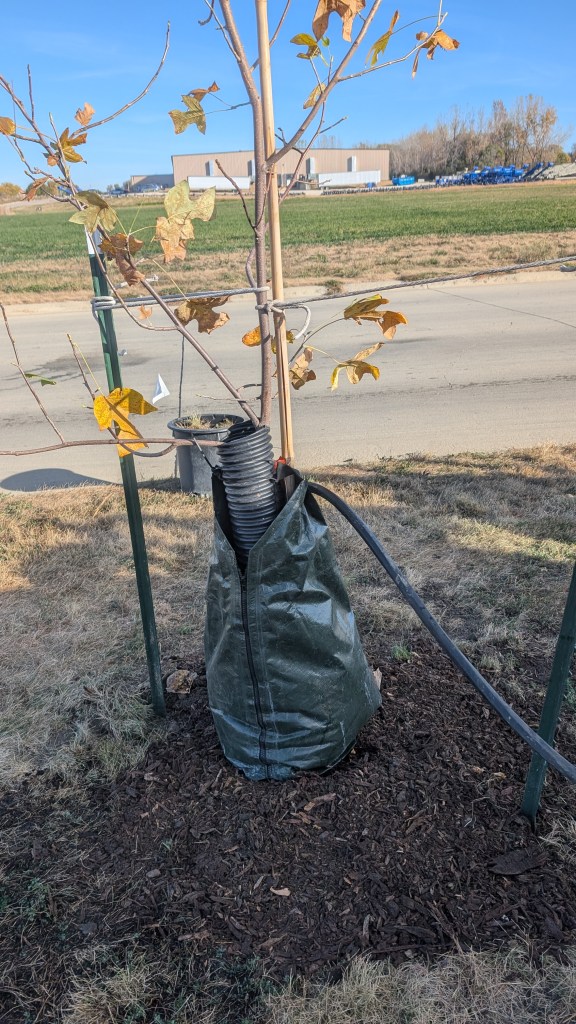
Watering: Providing enough water for young trees is the most important thing you can do to for long-term health (following proper planting techniques of course). The frequency and amount of watering varies based on area rainfall, moisture-holding capacity of the soil, and site drainage characteristics. A good general rule is that newly transplanted trees need an equivalent inch of rain or supplemental water every week to 10 days. That equates to roughly five to ten gallons of water for newly planted trees if you are not getting any rainfall. It is still beneficial in the late season to water trees all the way up until the ground freezes and no longer absorbs water readily. However, make sure to remove any watering buckets or gator bags from the tree so they do not freeze in place over winter. Once the ground is thawed and absorbing moisture in spring, watering can resume normally.
Mulching: Mulch serves many purposes, and it’s great to do an end-of-season check on your tree to see if it needs a new layer. During winter, mulch is an insulator for trees and helps prevent cold air from penetrating deep into the root zone. This reduces the likelihood of killing or stunting newly formed roots. Be sure NOT to pile the mulch against the trunk of the tree as that can also cause rot or pest harm. Create a mulch doughnut around the base of the tree leaving an empty space in the middle near the trunk. Don’t make a volcano pile around the base of the tree!
Wrapping and Protecting: Newly planted or young trees have thinner bark and can benefit from a little extra protection. Our wildlife friends will be searching for sources of food during winter and young trees will attract their attention. Plastic tubes will help against a variety of animals, such as rabbits and deer that want to munch on your tree. Make sure protection runs all the way to the base of the tree as burrowing animals and rodents may try to snack on lower bark during the winter. If deer population is high, consider fencing your young tree outside of the dripline (the diameter of ground directly below the outer edge of the leaf canopy) to keep them away. In addition to fending off wildlife, a white plastic tube will prevent the tree from sunscald. Sunscald occurs when the sun heats up the bark for a short period of time but then leaves it cracked and dry.
Supports: Free the tree! A final pre-winter health check of your tree is the perfect time to inspect and make adjustments or remove any potential restrictions from your tree. Stakes and tie-offs are great for newly planted trees that can’t stand on their own. However, once a tree is firmly settled into place, it is recommended to let the tree stand on it’s own and begin supporting its own weight and swaying (this will strengthen the trunk). To prevent injury, remove wires and tags against the trunk and branches so they don’t rub off bark, restrict branches, or get overtaken into the tree’s growth. Instead, use any strong, soft, wide strips of material, such as canvas or pantyhose if supports are necessary.
Choices now will impact your tree years down the road. Your tree isn’t just for you. Your tree is for the wildlife, the climate, and the generations to come!
For more in-depth tree maintenance information, visit our resources page. Resources – Trees Forever